
A figure older than his red coat
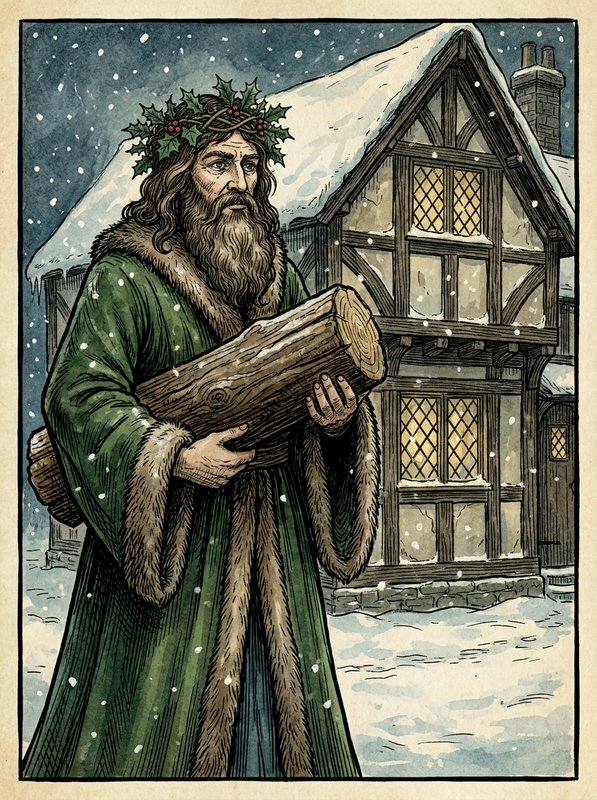
Father Christmas began as a personification of the season itself. The earliest surviving trace of him is a carol, "Sir Christemas", copied into an English manuscript in the fifteenth century, in which a figure by that name announces that Christ was born to save mankind and calls for feasting and good cheer. He was not a visitor who arrived down a chimney; he was midwinter given a voice and a name.
By the early seventeenth century he had become a stock character in English festive drama, most notably in Ben Jonson's 1616 masque "Christmas, His Masque", where he appears as an old man defending the old customs of hospitality, drinking and dancing against those who would rather see the season cut short. Some historians call this figure "Old Christmas" or "Sir Christmas": a symbol of the feast, wheeled out each year to argue that Christmas should be kept properly or not at all.
That older figure faded once Puritan authorities banned Christmas celebrations outright during the Commonwealth period, and he only partly recovered afterwards. He carried on in folk plays, mumming and popular print as a genial old man associated with feasting rather than presents, and it was this half-remembered figure that Victorian writers and illustrators later picked up and rebuilt, a story covered in the section on the Victorian revival below.
None of this makes him the same figure as Santa Claus, whose roots lie in the Dutch Sinterklaas and a nineteenth-century American reinvention. The two traditions ran side by side for a long time before merging in the twentieth century, a distinction covered in more detail on the Father Christmas and Santa Claus page.
The Victorian revival
A figure that had grown thin
By the early nineteenth century, the old midwinter personification of Christmas, the jolly figure who turned up in mummers' plays and carols to preside over feasting and drink, had faded into something close to a relic. Christmas itself had shrunk after generations of Puritan disapproval and slow, patchy recovery, and the character built around it had shrunk with it: an occasional prop in an old play. The Victorians did not invent him from nothing, but they had very little left to work with by the time they picked him back up.
Rebuilt for a different Christmas
What changed was Christmas itself. Over the middle decades of the century it became a domestic, family occasion in a way it had not reliably been before, helped along by illustrated newspapers, cheap printing, greetings cards and books written for exactly this new market, Charles Dickens's A Christmas Carol chief among them. Father Christmas was reshaped to suit that Christmas: a figure for the hearth and the children in the room. The green coat and the association with generosity both belong to this period, and are worth their own telling elsewhere on this site.
How much of this is genuinely old
Historians of Christmas do not fully agree on how much of the Victorian figure is continuous with the older one and how much is effectively new invention dressed in old language. Some point to real threads running back through midwinter custom; others treat the Victorian Father Christmas as a fresh character who borrowed a name and a beard from something older because it lent him weight. The honest position is that both things are true to some degree, and that the surviving evidence from before the Victorian revival is thin enough that certainty either way is not really available.
The wider story of how British Christmas customs took their present shape is told in full on Where the British Christmas customs came from, and the separate American strand that eventually met this one is covered in Father Christmas and Santa Claus: what is the difference?
What the green coat means, and when the red one arrived
The green coat
The earliest English pictures of a Christmas figure show him in green, or sometimes brown. He is an old man in a long fur-trimmed robe, often crowned with holly or ivy, standing for the season's plenty. He was drawn this way in pamphlets from the seventeenth century, when Old Christmas became a character in the argument over whether Christmas should be kept at all, and the green robe marked him out as a figure of the natural world, of evergreen branches and midwinter feasting.
The best-known version of this green-coated figure comes from Charles Dickens. In A Christmas Carol (1843), John Leech's illustration of the Ghost of Christmas Present shows a huge, jovial man in a green robe trimmed with white fur, seated on a throne of food. Dickens did not invent Father Christmas, but the book gave the old green-robed figure his most widely read Victorian outing, at exactly the point the whole holiday was being remade for a new kind of Christmas.
When red took over
Red became the more common colour later, and by a route that runs mostly through America. Illustrators there, among them Thomas Nast drawing for Harper's Weekly from the 1860s onward, had already been putting Santa Claus in red and white for decades. The idea that Coca-Cola's advertising invented the red suit in the 1930s is a popular story, but the colour was established well before the company's illustrator, Haddon Sundblom, took it up. What Coca-Cola's advertising did was spread one particular red-suited image very widely and very consistently, and it is that image, arriving back in Britain through film, print and advertising through the twentieth century, that gradually pushed the older green Father Christmas toward the edges.
The two figures were never quite the same person to begin with, and the difference between them is covered in more detail on Father Christmas and Santa Claus: What Is the Difference?. What can be said plainly here is that the coat was green a long time before it was red, and that the change owes as much to American commercial illustration as to anything that happened in Britain.