
The customs are newer than they look
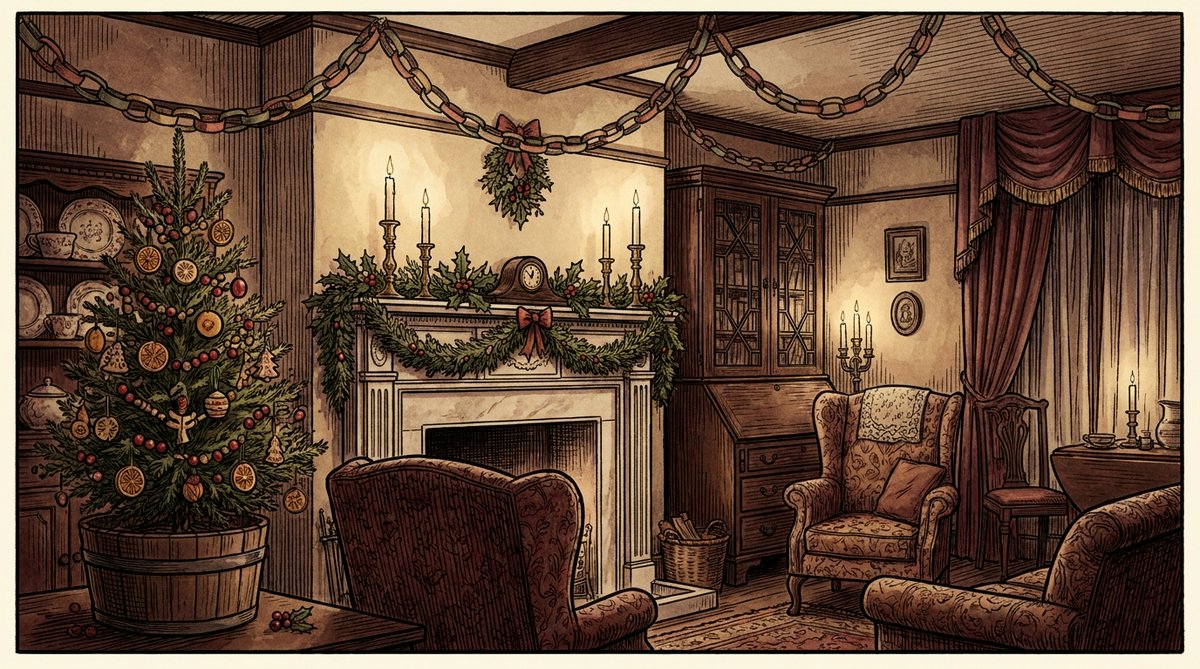
Most British Christmas customs feel as though they have always been there, fixed and immovable, the same year on year since some distant beginning. Very few of them are that old. Most of what fills a modern British Christmas, from the tree in the corner to the cracker on the table, arrived within the last two hundred years, and often from somewhere other than Britain.
That does not make them less worth keeping. A custom does not need to be ancient to matter; it needs only to be shared, repeated and handed on, which is exactly what these have been, generation to generation, since the households that adopted them first. Knowing where a custom came from does not take anything away from it. If anything it adds something: a stocking hung by a fireplace stops being simply a thing you do and becomes a thing with a history, borrowed and reshaped by people solving a particular problem in a particular year.
The pages that follow take three groups of custom in turn:
- Holly, ivy and the Christmas tree, and which of the three is genuinely medieval, which is Victorian, and which came from Germany.
- Crackers, carols and the stocking, including the one invented outright by a single named man, Tom Smith.
- Mince pies, the pudding and Boxing Day, and how far the meanings behind those names have drifted from where they started.
Each section names its source and its date, because traditionally and it is said are not answers, they are ways of avoiding one. Where an origin is genuinely disputed among historians, that dispute is set out plainly.
Holly, ivy and the Christmas tree
Holly and ivy: older than Christmas, but how old exactly?
Holly and ivy were being brought indoors in Britain long before anyone called the season Christmas. Churches and homes were dressed with evergreen boughs through the winter months, and by the fifteenth century town accounts and churchwardens' records mention holly bought specifically for the season. The carol most people know, "The Holly and the Ivy", was printed by Joshua Sylvester in 1861 as part of a collection of English carols, though the words and tune are almost certainly older than that printing and their exact age is not settled.
The idea that holly and ivy are pagan survivals, carried over from Roman midwinter customs and only later given a Christian gloss, is repeated often but is not as solid as it sounds. The historian Ronald Hutton, whose work is the standard modern account of this question, argues that the direct line from Saturnalia to a Victorian parlour is mostly assumed: the medieval sources describe the greenery as decoration and as a mark of the season. That does not mean the plants have no older story, only that the story usually told about them is thinner than it looks. Readers wanting the fuller picture of what the darkest weeks of the year meant before Christmas existed as a festival can find it on the page about midwinter before Christmas.
The Christmas tree: German first, then royal, then everyone's
The decorated tree is German in origin and much older in Germany than it is in Britain. Diaries and guild records from Strasbourg describe trees set up and hung with fruit and paper decorations from at least the early seventeenth century, well before the custom crossed the Channel. In Britain, the tree is usually credited to Prince Albert, but German members of the royal family, including Queen Charlotte, are recorded as having Christmas trees at Windsor as early as 1800, decades before Albert married Victoria.
What actually changed the custom's fortunes in Britain was not its introduction but its publication. The Illustrated London News printed an engraving in December 1848 showing Victoria, Albert and their children gathered round a decorated tree at Windsor. The image was widely copied and imitated, and it is this picture, more than any single act of importing the custom, that is usually credited with putting a tree in front of the British middle classes for the first time. So the tree is German by invention, aristocratic by early adoption in Britain, and Victorian by the point at which it became a household custom.
Readers who want the fuller, more sceptical account of which British customs are genuinely old and which are Victorian invention dressed as tradition should go to Ronald Hutton's The Stations of the Sun (Oxford University Press, 1996), which remains the most thorough modern treatment of the question and names its sources.
Crackers, carols and the stocking
The cracker Tom Smith invented
The Christmas cracker is not a borrowed custom at all: it was invented, by a single named tradesman, whose product still carries his name. Tom Smith was a London confectioner who packaged sweets in twists of paper in imitation of French bonbons during the 1840s, sold in shops for the Christmas trade. He is usually said to have added the snap after hearing a log crackle in his own fire, so that pulling the wrapper apart made a small bang, and to have dropped the sweet in favour of a paper hat, a motto and a small trinket within a couple of decades. The date most often given for the snap is 1847, though as with much Victorian trade history the exact year rests on the company's own later account of itself rather than an independent record made at the time.
The three things inside a cracker settled into a fixed set within a few decades:
- a strip of card that makes the snap when pulled
- a paper hat, usually a crown
- a small gift or trinket, and a printed motto or joke
None of that owes anything to midwinter folklore. It is a piece of Victorian retail invention that took hold because it worked at the table, and it has changed very little since.
Where carols came from before they were about Christmas
A carol was originally a dance-song, sung at any of the year's festivals. Carol singing at Christmas nearly disappeared in England during the mid-seventeenth century, when Oliver Cromwell's government discouraged the public celebration of Christmas itself alongside much else it considered frivolous, and many older carols survived only in oral tradition in rural parishes rather than in print. Their revival is largely a Victorian project: William Sandys published Christmas Carols Ancient and Modern in 1833, collecting songs that had been sung locally for generations and were at real risk of being lost, and the book is usually credited with putting carol singing back into middle-class parlours. Some familiar tunes are older than the words sound, and some familiar words, such as Cecil Frances Alexander's Once in Royal David's City, written in 1848, are entirely Victorian and only feel ancient because they are sung the same way every year.
The stocking, and the legend behind it
Hanging a stocking by the fire is the one custom here that reaches back past Victorian Britain, to a European legend about Saint Nicholas, who was said to have dropped gold coins down a chimney that landed in stockings left out to dry. That story belongs to Saint Nicholas rather than to Father Christmas, who was a separate figure in English tradition until the two were merged during the nineteenth century, a distinction covered more fully on Father Christmas and Santa Claus: What Is the Difference? What is clear is that the British custom of an actual stocking, hung on a mantelpiece and filled overnight, is a nineteenth-century domestic practice, and no single English source fixes the date it began.
William Sandys's 1833 collection, Christmas Carols Ancient and Modern, is in the public domain and a copy is held by the British Library, along with his introduction explaining which carols he found already dying out before he began writing them down.
Mince pies, the pudding and Boxing Day
Mince pies: from spiced meat to shrunken sweet
A mince pie today is a small sweet pastry, filled with dried fruit and spice, sold by the box from November onward. It began as something much larger and much less sweet: a medieval Christmas pie, oblong in shape, packed with minced mutton or beef alongside dried fruit and imported spices such as cinnamon, cloves and nutmeg, which were themselves a mark of the season because they were too costly to use the rest of the year. The oblong shape is often said to represent the manger, though the pies were known simply as Christmas pies or shred pies long before that explanation was written down anywhere.
The meat left the recipe slowly. Cookbooks through the eighteenth century kept dropping the meat while keeping the suet, which is why a jar of mincemeat still carries that name today despite containing no meat at all. By the Victorian period the pie had shrunk from a family-sized dish to the individual pastry served now, and the filling had settled into the fruit-and-spice mixture recognisable today.
The pudding: from porridge to pudding basin
Christmas pudding started life as frumenty, a spiced, boiled-wheat porridge eaten in the run-up to Christmas as a fasting dish. By the seventeenth century it had thickened into what cooks called plum pudding, boiled in a cloth, and stuffed with dried fruit. The word plum meant dried fruit generally, raisins and currants.
A story often repeated credits George I with fixing plum pudding as a royal Christmas dish, after he is said to have requested it at his first English Christmas dinner in 1714, from which the pudding is sometimes called George's pudding. The account gets repeated as though settled, but it is difficult to trace back to a contemporary source, so it is worth treating as a story that circulates.
Boxing Day: whose box, and whose day
The 26th of December has an older name than Boxing Day: St Stephen's Day, the feast named in the carol "Good King Wenceslas," where the king looks out "on the feast of Stephen." Boxing Day is the later addition, and the two explanations usually offered for it do not agree with each other.
One explanation holds that servants and apprentices collected a Christmas box of tips from employers and customers the day after Christmas. Samuel Pepys recorded giving one in his diary in the 1660s, and the custom of tipping tradespeople around this date has stayed close to that meaning ever since. The other explanation points to church alms boxes, opened on St Stephen's Day so their contents could be given to the poor. Both are old enough to be plausible, and neither has settled the question.
A pudding going wrong under pressure is the shape of the story told in The Pudding Problem, and the older midwinter customs that these Christmas ones grew out of are covered on Midwinter Before Christmas.