
One name became two figures, and two figures became one again
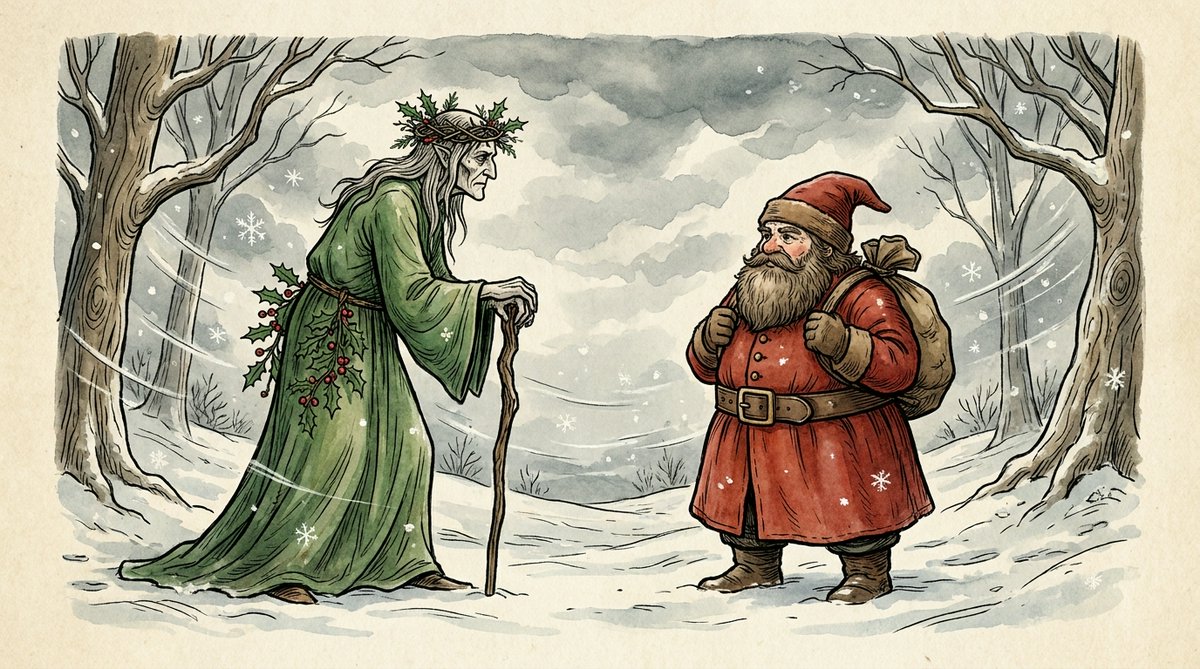
Ask a British child and an American child to draw the man who comes at Christmas and you will likely get two different pictures, though they now share a red coat. That is because Father Christmas and Santa Claus began as separate figures in separate countries, with separate jobs, and only became one another over the course of the nineteenth and twentieth centuries.
Father Christmas is the older of the two names in England, recorded from the fifteenth century as a personification of the Christmas season itself, an adult figure of feasting and goodwill. Santa Claus descends from Sinterklaas, brought to America by Dutch settlers, whose feast day and saintly origins in Saint Nicholas of Myra were reshaped by nineteenth-century American writers into the gift-giving figure familiar today.
The two names get used interchangeably now, in Britain as much as anywhere, but they were not always describing the same tradition. This page sets out what each figure actually brought with him: where he came from, what he wore, what he did on the night itself, and the stories that were told about him before the two got folded together.
The sections that follow work through that separately for each figure, and then look at how the merger happened and what, in the process, was quietly lost.
Father Christmas and Santa Claus, side by side
The two figures are often drawn as if they were always one, so this sets out what each brought before they merged: where he came from, how he looked, and what stories were told about him.
| Figure | Where he came from | How he looked | What the stories tell |
|---|---|---|---|
| Father ChristmasVictorian sources disagree on how much of him is genuinely medieval and how much was invented in the 1800s to feel that way. | A medieval English figure, a personification of the Christmas season, who turns up in mummers' plays and was revived and reshaped by Victorian writers keen to restore old midwinter customs. | A long green or fur-trimmed robe, a crown of holly, an older bearded man closer in spirit to a guest presiding over a feast than a figure descending a chimney. | Stories built around him are about hospitality and the turning of the year, an arrival that marks the season. |
| Santa ClausThe workshop, elves and reindeer are a later American layer. | A 19th-century American figure, built from the Dutch Sinterklaas by Dutch settlers in New York and given his familiar form by Clement Clarke Moore's 1823 poem and Thomas Nast's newspaper drawings. | The red suit, the sleigh, the reindeer and the rounder, jollier face, an image later fixed further by advertising illustration through the early and mid 20th century. | Stories centre on a North Pole workshop, a list of children and a night-long journey by sleigh, a body of mythology covered in depth on santaclaus.uk. |
This is a plain reading of the two folklore traditions, and it does not cover the North Pole, workshop or reindeer mythology, which santaclaus.uk sets out on its own terms.
How the two merged
By the middle of the twentieth century, most people in Britain used Father Christmas and Santa Claus as if they were the same name for the same person, and in most everyday senses they now are. That merging did not happen at a single date. It came about through a slow exchange of images, illustration and film between Britain and America over roughly a hundred years, so that two figures who had started out doing quite different jobs settled into one shared appearance.
The routes the merger travelled
Nineteenth-century American writing did most of the early shaping. Washington Irving's satirical Knickerbocker's History of New York (1809) and Clement Clarke Moore's poem "A Visit from St. Nicholas" (1823) gave American readers a Dutch-derived Saint Nicholas who rode through the sky and slipped down chimneys. The illustrator Thomas Nast then gave that figure a face, a fur-trimmed suit and a home at the North Pole in drawings for Harper's Weekly through the 1860s to 1880s, well before any advertising campaign is usually credited with the look. Those images crossed the Atlantic through children's books, Christmas cards and, later, cinema, arriving in Britain layered on top of a native Father Christmas who had never needed a workshop or a sleigh full of reindeer to do his job.
What the older figure lost
The British Father Christmas that the incoming Santa Claus met was, in his older form, less a bringer of presents than a personification of the season itself: a robed, garlanded adult figure who appeared in mummers' plays and carol texts to preside over feasting and goodwill, with children's gifts a minor part of what he stood for. As the American imagery took hold, that older sense thinned. The name stayed, because the British already had one, but the chimney-visiting, present-leaving figure of the merged tradition owes more to the imported Santa Claus than to the mummers' Father Christmas he largely replaced.
Why the two Christmases still feel different
Britain kept the name Father Christmas and, with it, a faint memory of the older figure: an adult presence at the feast as much as a visitor to the nursery. America kept the fuller mythology, the North Pole, the workshop and the reindeer, developed and elaborated at that end of the exchange rather than this one; that part of the story belongs to Santa Claus and is told properly elsewhere, not here. What is left is a difference of emphasis. It shows up in small, unremarked choices: the name a household uses, and what it assumes that name is for.