
The darkest week was already marked, long before it had a name
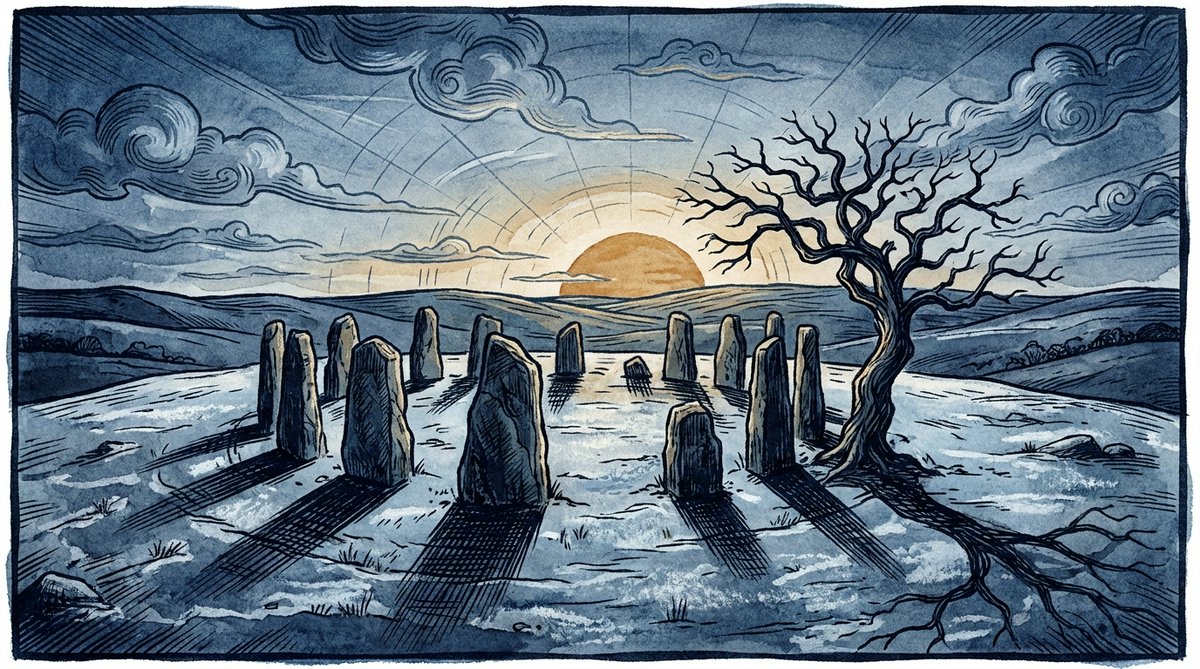
The winter solstice falls in the days around 21 December, when the northern hemisphere tips furthest from the sun and daylight in Britain is at its shortest for the year. That is a fact of astronomy, not belief, and it would have been plain to anyone watching the sky long before any calendar called this week Christmas.
People met that darkness with fire. A fire lit at the year's darkest point answers a practical need, light and warmth where both are hardest to come by, and it needed no religious calendar to make sense of it. What is harder to say is which practices did this, in which century, and under what name: the written record for pre-Christian Britain is thin, and much of what gets called midwinter tradition was set down centuries after the fact, by writers describing customs that were already old when they wrote about them.
That gap runs through the rest of this page. The sections below on Yule, Saturnalia and the solstice weigh what is actually attested against what was reconstructed or invented later by people who liked the idea, and look at how Christmas took on midwinter customs that were already keeping the dark at bay. For the customs that followed, once the week did have a name, see Where the British Christmas customs came from.
Yule, Saturnalia and the solstice
Saturnalia
Saturnalia is the best attested of the three. Roman writers described it directly: Macrobius devoted a set of dialogues to it in his own Saturnalia, written in the early fifth century, and Catullus, writing centuries earlier, called it "the best of days". It ran for about a week in mid-December, honouring the god Saturn, and turned ordinary household order briefly upside down: masters waited on slaves, gambling was allowed in the open, and small gifts called sigillaria changed hands. None of that is guesswork. It comes from people who were there or close to it, in texts that still survive.
Yule
Yule is older as a word than it is as a description. It appears in Old Norse sources, the Poetic Edda and Snorri Sturluson's Prose Edda, both written down in the thirteenth century, well after Scandinavia had turned Christian. The English monk Bede gives the earliest English mention, in his De Temporum Ratione of 725: he names a month "Giuli" and records a pagan observance called Modraniht, Mothers' Night, on its eve, but he says almost nothing about what actually happened. What survives is a name and a date, not a description of the custom itself.
The solstice
The solstice itself needs no attesting. The shortest day is an astronomical fact, and a monument such as Stonehenge is aligned to it in ways that can be measured on the ground. What cannot be recovered is what the people who built it believed or did there, because they left no writing behind. Any account of "solstice worship" beyond the alignment itself is reconstruction, however well it fits the shape of the stones.
What came later
Much of what people now call Yule, as a full set of customs with a Yule log, a Yule tree and a settled run of rites, was assembled well after the event by antiquarians and folklorists who wanted a continuous pagan thread running under Christmas. Jacob Grimm's Deutsche Mythologie (1835) did a good deal of that assembling, and twentieth-century neopagan writing built further on it. The historian Ronald Hutton examines the gap closely in The Stations of the Sun (Oxford University Press, 1996), setting out what the medieval and classical sources actually say against what later writers added because the idea suited them. A custom can be old without being unbroken, and those are not the same claim. How these layers eventually folded into Christmas itself is covered on the page about where the British Christmas customs came from.
How Christmas took over an older season
Christmas did not arrive into an empty calendar. The week around the shortest day already carried its own customs of fire, feasting and evergreen, and when the Christian festival was fixed nearby, it did not clear that ground so much as build on it. A custom that once marked the turning of the year could go on being kept, only now under a different name and with a different story attached to why people were doing it.
Two things can be true of the same custom
A candle in the window, a fire kept burning, a sprig of holly brought indoors: each of these can be read as a Christian gesture and as a much older one, and often both readings are correct at once. The custom did not have to choose a single meaning to survive. What changed, over centuries, was less the action than the explanation people gave for it, and the explanation is usually the newer layer.
How to tell which layer you are looking at
A rough test helps more than a rule. Ask what the custom actually does: if it marks the return of the light, or wards off the dark, or gathers people at the year's turning point regardless of what is said over it, it is likely to belong to the older, midwinter layer. If it commemorates a specific event in the Nativity story, or depends on a text or a church calendar to make sense, it belongs to the Christian layer laid over the top. Many British customs sit somewhere between the two, which is why writers on the subject disagree about where one ends and the other begins.
The distinction matters for reasons beyond tidiness. A family lighting a fire on the darkest night of the year is taking part in something considerably older than Christmas itself, and knowing that changes what the gesture means without taking anything away from it.
A story built on exactly that darkest night is The Longest Night. The wider account of where British customs came from, layer by layer, is on Where the British Christmas Customs Came From.